Isaac ROS SIPL Camera#
Overview#
Isaac ROS SIPL Camera provides ROS 2 camera driver nodes for NVIDIA SIPL (Safe Image Processing Library) cameras with zero-copy GPU-accelerated image publishing through NITROS.
SIPL is NVIDIA’s modular camera framework for Jetson, providing a unified API and driver model that exposes hardware accelerated ISP for continuous image streaming from sensors. See Introduction to SIPL and the UDDF (SIPL) drivers used to integrate sensors.
SIPL is the primary, streaming-oriented camera framework for Jetson and the long-term path for new camera framework features, superseding the earlier Argus framework. For a comparison, see Camera Development in the NVIDIA Jetson Linux Developer Guide. Argus will continue to be maintained in JetPack but the Isaac ROS integration was dropped since Isaac release 4.0.
CoE is the next-generation Ethernet-based camera transport enabling high-performance, flexible, and scalable camera integration using standard Ethernet networks.
The Holoscan Sensor Bridge (HSB) is the CSI-to-Ethernet bridge hardware that turns MIPI/GMSL sensors into CoE cameras and tunnels their control and image data over Ethernet.
GMSL2 is a high-speed serializer/deserializer link that carries MIPI camera data over coax. SIPL also drives GMSL deserializers directly, so GMSL cameras such as the Leopard Imaging Hawk attach to the Jetson on-board.
Key features include:
Hardware-accelerated ISP with no host copy from capture through the Jetson on-chip ISP to CUDA-accessible memory
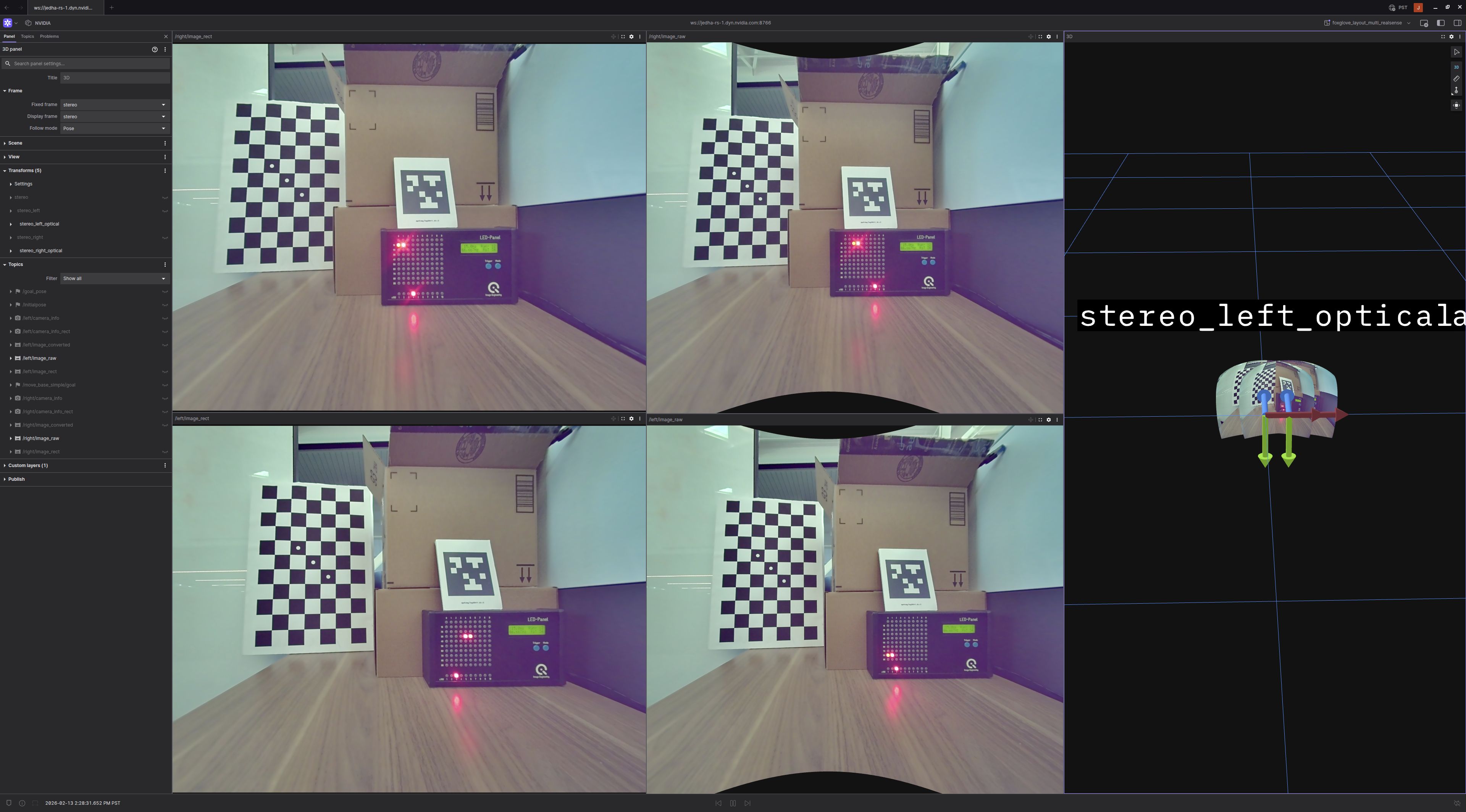
Mono and stereo camera support with independent capture threads per sensor
No GPU-to-host copy publisher subscriber with NITROS, keeping image data on the GPU between ROS nodes
Camera calibration importing to publish accurate intrinsics in ROS
camera_infofor rectification and downstream perceptionREP-103 static TF publication to define camera and optical frames based on imported calibration data
Known Limitations#
Note
SIPL support for JetPack CoE and GMSL stereo cameras is in early development and is expected to improve in future releases. There are limitations of the framework that apply as of the current release.
The following known limitations apply:
Calibration from file import only: The provided camera drivers do not yet support extracting calibration data from the camera EEPROM. Import the calibration files to the ROS nodes as described in the Isaac ROS SIPL Camera documentation.
ISP output formats: The node supports only native NV12 or NV24 output from the ISP. Use the
ImageFormatConverterNodeincluded in the example launch files for other formats.Only single GMSL camera link at a time: As of the Jetson Linux (L4T) R39.2 release, concurrent capture from multiple cameras is not supported from the underlying SIPL and deserializer drivers.
HSB camera configurations conflict with the same config name: As of the Jetson Linux (L4T) R39.2 release, the SIPL query parser treats each CoE transport’s camera config name as a globally unique key, so it rejects configurations that bind more than one Holoscan Sensor Bridge (HSB) transport to the same config name. This prevents multiple HSB camera configurations from loading. As a workaround, assign a unique camera config name to each HSB transport instead of reusing one name across multiple HSBs.
Isaac ROS NITROS Acceleration#
This package is powered by NVIDIA Isaac Transport for ROS (NITROS), which leverages type adaptation and negotiation to optimize message formats and dramatically accelerate communication between participating nodes.
Quickstarts#
Packages#
Supported Platforms#
This package is designed and tested to be compatible with ROS 2 Jazzy running on Jetson.
Platform |
Hardware |
Software |
Storage |
Notes |
|---|---|---|---|---|
Jetson |
128+ GB NVMe SSD |
For best performance, ensure that power settings are configured appropriately for your platform: Jetson Thor power settings or Jetson Orin power settings. |
Updates#
Date |
Changes |
|---|---|
2026-08-18 |
Added SIPL support for the Leopard Imaging Hawk GMSL2 stereo camera with paired stereo output with aligned timestamps |
2026-07-06 |
Improved timestamp correlation, launch argument handling, and test robustness |
2026-04-30 |
Compatibility and integration updates for the Isaac ROS 4.4.0 release |
2026-03-23 |
Initial release |