

CUDA with NITROS#
Overview#
CUDA is a parallel computing programming model and helps robotic applications to implement functions that would otherwise be too slow on a CPU.
CUDA implemented in a ROS 2 node can take advantage of NITROS, the Isaac ROS implementation of type adaptation & type negotiation which enables accelerated computing in ROS 2.
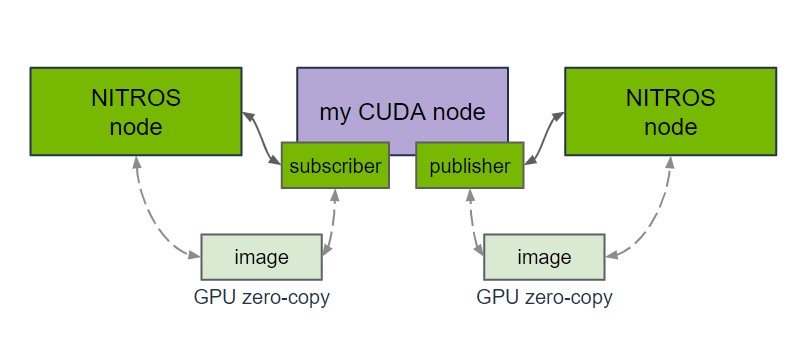
By using the NITROS publisher, CUDA code in a ROS node can share its output in GPU accelerated memory to NITROS enabled Isaac ROS nodes. This improves performance by avoiding CPU memory copies, and increasing the parallel compute between the GPU compute and CPU processing. NITROS maintains compatibility with other ROS nodes subscribing to the topic such as RViz.
By using the NITROS subscriber, CUDA code in a ROS node can receive its input in GPU accelerated memory from a NITROS enabled Isaac ROS node, or another CUDA enabled ROS node publishing by using a NITROS subscriber. This has the same benefits of reducing CPU memory copies and increasing parallel computing between the GPU and CPU.
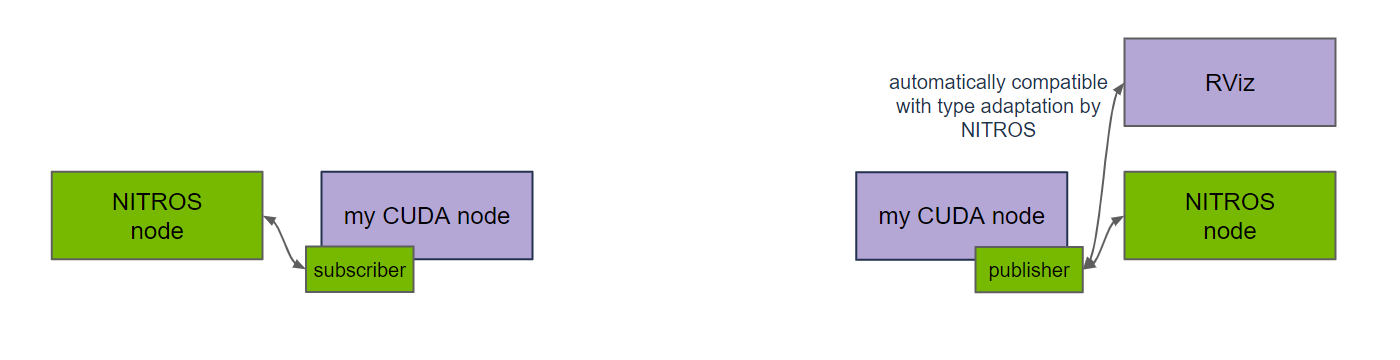
NITROS publisher and NITROS subscriber enable many design patterns compatible with Isaac ROS accelerate computing nodes, and traditional CPU nodes. For example publishing from a CUDA node directly to an Isaac ROS node, or visa-versa from an Isaac ROS node to a CUDA node. A CUDA node can be inserted between two Isaac ROS nodes, or even use multiple CUDA nodes in succession, all with the benefit of CUDA accelerated computing in each node. This creates more modular software designs, as CUDA accelerated functions can be packaged in individual nodes, instead of packing them together into a larger single node.
Core Concepts#
Managed NITROS Publisher#
The Managed NITROS Publisher provides a familiar interface
for publishing messages into NITROS-enabled graphs. The API is
comparable to the standard rclcpp::Publisher API, making it easy to
add a Managed NITROS Publisher to an existing ROS 2 node.
Managed NITROS Publishers are specifically designed to publish
NITROS-typed messages. These NITROS types are listed under the
isaac_ros_nitros_types subfolder.
Note
Currently, the Managed NITROS Publisher is compatible
with the isaac_ros_nitros_tensor_list_type, isaac_ros_nitros_image_type, and
isaac_ros_nitros_point_cloud_type. These types enable you to send and receive tensors, images, and point clouds
to and from packages in Isaac ROS DNN Inference and other CUDA-accelerated applications.
Managed NITROS Subscriber#
The Managed NITROS Subscriber is analogous to the Managed NITROS
Publisher, offering a straightforward, rclcpp::Subscriber-like
interface for subscribing to messages from NITROS-enabled graphs.
Managed NITROS Subscribers are specifically designed to receive
NITROS-typed messages. These NITROS types are listed under the
isaac_ros_nitros_types subfolder.
Note
Currently, the Managed NITROS Subscriber is compatible
with the isaac_ros_nitros_tensor_list_type, isaac_ros_nitros_image_type, and
isaac_ros_nitros_point_cloud_type.
NITROS Builders#
NITROS Builders are a series of utility classes that streamline the process of creating a NITROS-typed message. These classes offer a builder-style interface, allowing developers to specify relevant fields for object construction one at a time:
using namespace nvidia::isaac_ros::nitros;
NitrosTensorList tensor_list = NitrosTensorListBuilder()
    .WithHeader(ros_header)
    .AddTensor("tensor_1", foo_tensor)
    .AddTensor("tensor_2", bar_tensor)
    .Build();
The collection of NITROS Builders also includes additional builders that
construct individual components of the broader NITROS types. For
example, a NitrosTensorBuilder can be used to produce a
NitrosTensor that is subsequently consumed by a
NitrosTensorListBuilder, and a NitrosPointCloudBuilder can be used to
create point cloud messages with CUDA data.
NITROS Views#
NITROS Views are a series of utility classes that simplify the process of accessing fields of a NITROS-typed message. These classes offer an analogous interface to the NITROS Builder, allowing developers to retrieve specific portions of a composite structure and process them accordingly.